The problem
A new territory layout means owner changes in Salesforce, and a bad one moves real books. Leaders needed a place to try a layout before any rep’s book moved, and a careful path for the change once a layout was chosen.
What I built
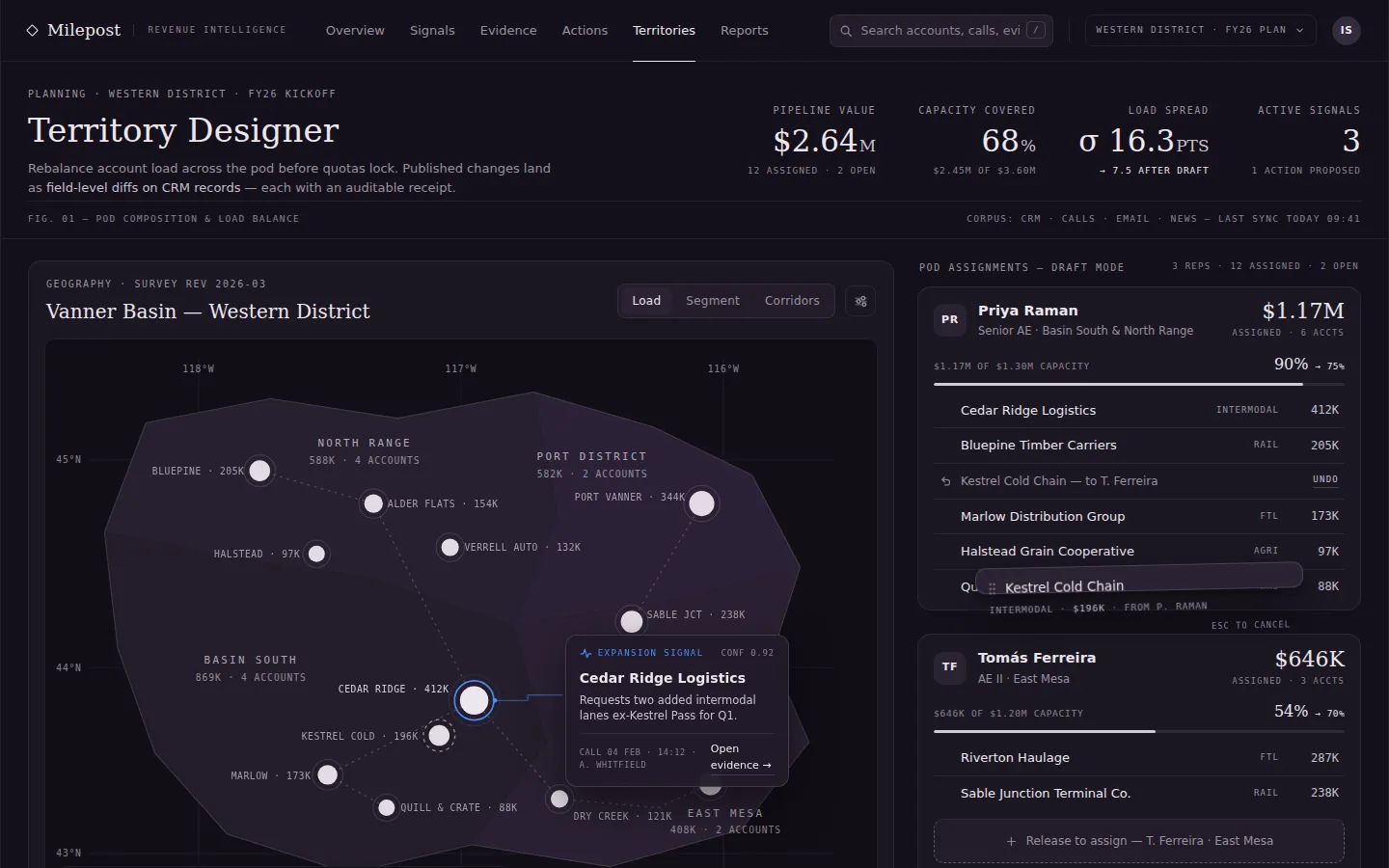
A what-if sandbox in the platform. It draws regions from account data, assigns reps to them, and lets a leader edit the result on the map.
It never writes to Salesforce. Live changes went through a separate bulk update with a canary. The map beneath it geocodes accounts in three passes (US Census batch, then ZIP centroid, then a postal-area centroid) and applies filters before a 2,000-pin cap, while still showing the true count.
How it works
The rule is shapes first, names second. Seeds are spread by account mass, and regions grow in a balanced way around running weighted centroids.
A boundary pass then moves m accounts from region j to a neighbour u only when dev_j > dev_u + m. Each such move makes the sum of squared deviations strictly fall, and that sum cannot fall forever, so the loop ends. A smoothing pass follows for compactness.
Only then are reps named. I matched them to regions by distance from home with an exact minimum-cost assignment: brute force for small sizes, the Hungarian algorithm above that.
A second stage, the connected-patch optimizer, fixes regions with stray lobes. It makes reciprocal swaps that move both lobes in one step. It sits behind a flag, and a golden hash test proves that flag-off output is byte-identical to the code before it.
What went wrong
The plan’s own pseudo-code held a rebalance rule that oscillated; writing the tests first exposed it. Later the optimizer found nothing to swap. I instrumented the zero-candidate case: none of about 2,000 candidates were connected on the corner-stripped graph, against about 250 on the physical graph. I was checking connectivity on one graph and measuring the cut on another, so I amended the design to give each graph its own job.
Owner reassignment ran as snapshot, three-row canary, verify by query, full run, per-value count check, rollback file. The canary still could not catch three malformed ids that came from a repair in the middle of the CSV. A canary tests the method, not every row.
What it proved
Every region came out connected, two runs on the same input were byte-identical, compactness rose 6.2% over the first version, and a full run took under a second. With the optimizer on, edge cut fell 19% and rep-level spikes fell by about a fifth. The price was a wider spread in balance, which I judged right for a map people read by eye.